Essay · Nov 2026 · 9 min read
Reviews and Ratings
Reviews and rating systems as we know them don’t work. Here’s why, and what could fix them.
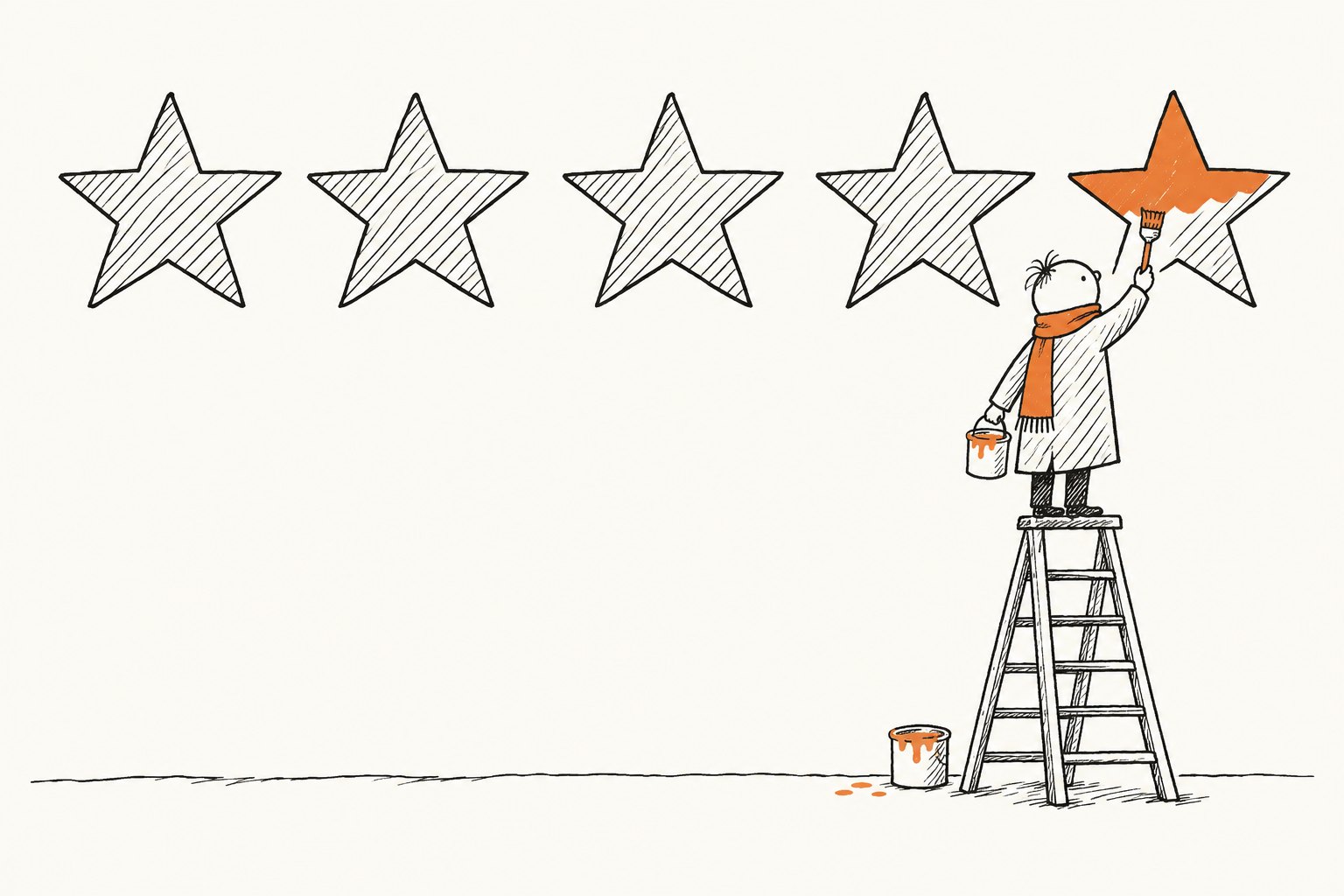
Reviews and rating systems as we know them don’t work.
We are overwhelmed with stuff right now. There is too much out there: too many products, movies, restaurants and services, and the volume of digital ‘stuff’ is only increasing. We can’t assess them all, so we rely on reviews and ratings as a proxy, a filter for what’s good.
Reviews exist to reduce the limited time we have on this planet spent deciding and curating, to help us make consumer decisions and, importantly, to reduce the likelihood of us making bad decisions (or being seen to make one).
In this scenario a bad decision could mean you eat somewhere you don’t enjoy, you buy a product you don’t like or that doesn’t work for you, you waste time or, correspondingly, money. Or it could be that you feel like you will lose social capital with friends, partners, family or romantic interests because you haven’t done your research, put effort in or, worse, just have poor judgement.
In a lot of cases maybe it doesn’t even matter, or maybe the scale isn’t even that large. There could be 100 steak restaurants, but would you be able to tell the difference between #51 and #52? Or even #51 and #1?
Whole businesses exist to tell us what is the best restaurant, best car or best camera, but a lot of the time the variation just isn’t that great and we’d be just as happy with (or not notice the difference from) something mediocre.
There is also obviously a relationship between the consequence or relative cost of a decision and the value of a review. For example, if you’re looking at a phone holder for your car, as long as a product has reviews and they aren’t significantly different from another example, you probably shouldn’t waste another second looking and should just buy the first half-decent one you see.
That is, unless you like to be ‘the guy with the good recommendations’, you are known as a trusted source and would hate to break that persona.
Reviews and ratings are really just a cover for you not having to make a decision. You’ve outsourced it to someone else and spared yourself the cognitive load: why do I need to decide on the best backpack if they have done it already?
It is rare for people to seek to make decisions. We avoid them wherever we can, and reviews are fantastically helpful for that.
But let’s assume for now that, on balance, reviews and ratings are useful. What stops them from working today?
The four problems with reviews and ratings
1. Gaming
Almost all large review platforms can be easily gamed.
Go on a tour on holiday and you’ll likely sit awkwardly while the guide shares a TripAdvisor QR code with you, hovering as you give them 5 stars. Restaurants offer money off a future visit if you show them you left a positive TripAdvisor or Google review.
Apps and websites carefully decide when to show you a Trustpilot or App Store review page (after you’ve found value in the product) versus an in-product feedback form (when you’ve been frustrated).
Or, even more egregiously, there are communities and offers to ‘swap’ or buy reviews for platforms like G2 for business software.
There’s obviously a balance here. Businesses want to be able to demonstrate their quality and service, and find ways to encourage more reviews, but it means those reviews are rarely unbiased.
As a result you end up with absurd 4.9 or 5 star ratings across thousands of reviews, and distinctly average restaurants being named ‘World’s best’ just because they know how to play the game.
In these cases I’m reminded of the Jeff Bezos story about how he was told by his execs how good and fast Amazon’s customer service was, only for him to call it during a board meeting and have everyone sit there painfully as they blew through their ‘average’ wait times. The lesson: when the anecdotes don’t match the data, you should question the data and dig in.
A bigger problem is emerging here too, with more and more of us using AI to find our next purchases. LLMs often rely on what they assume to be ‘independent’ and ‘trusted’ sources, review platforms and listicle blogs, to feed you options and alternatives. If the data being used has been gamed, you are going to be given bad recommendations.
2. Everyone’s a winner
The second problem is that even when rating honestly and truthfully, we just aren’t good raters and reviewers. We are far too kind.
In a useful rating system, reviews would be roughly distributed as a bell (or normal) curve, with an average (normalised or not) of 2.5 stars, 5 out of 10 or 50%. But this is obviously not the reality.
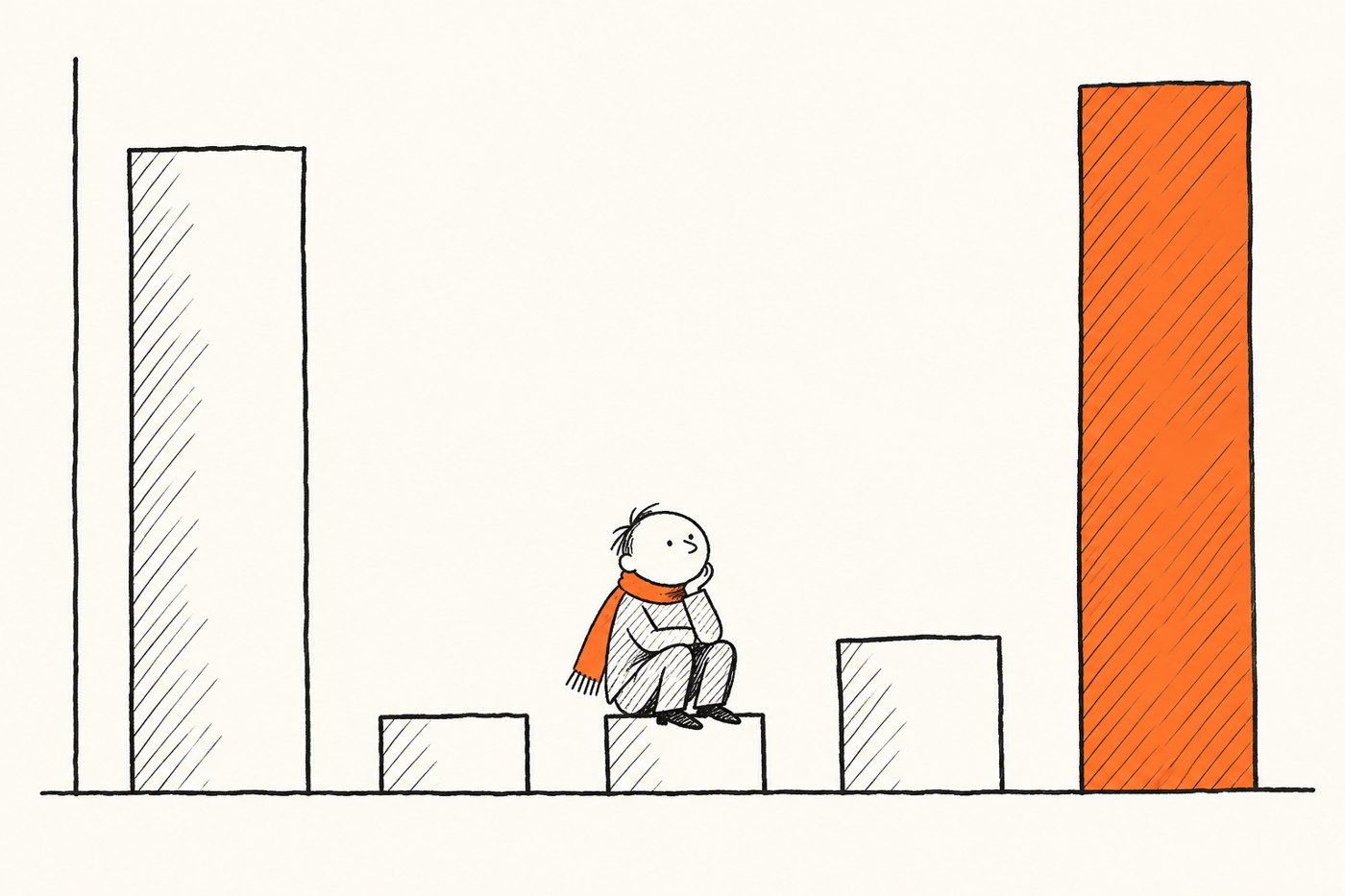
How many Ubers would you get into with a 2.5 star rating? Or how many restaurants with a 2.5/5 Google review would you eat at?
In fact, have you ever given less than 5 stars to an Uber driver? And if you have, I bet they had to do something pretty atrocious, and even then it was probably still a 3 star (above average, mathematically) rating.
While not perfect, Japan’s Tabelog (for restaurant discovery and booking) has one of the best rating systems I have seen. It is a 1–5 rating scale, but it weights ratings by how many other reviews a user has left, how their reviews correlate with other reviewers’, how many times they have eaten that type of cuisine and more.
As a result, it is all but impossible for a restaurant in Japan to achieve a 5 rating. The highest is around 4.6, the top 0.5% are above 4 and the top 5% are above 3.5, meaning you feel you can trust the score more and make better and faster dinner decisions. Not only that, but the reviews left alongside the ratings are extremely detailed and in-depth, commenting on the day of the week they visited, which chef was cooking and the exact courses they ate. Each user also has their own profile showing how many reviews they have left and how many followers they have.
On most platforms the default is 5 stars, knocking a star off for poor performance, whereas in Japan you feel you have to earn each star instead. It’s a small change in framing that has a big impact.
3. Everybody lies
The other side of a review or rating is that people give what they think other people would give, rather than what they like, want and would buy again.
Look at the ratings for Nando’s, McDonald’s or the chain Gordon Ramsay restaurants: they’re probably high 3s or low 4s on Google. But then consider how many people choose to go back regularly (given the plethora of low-friction options available, this is one of the best signs of a customer’s real review).
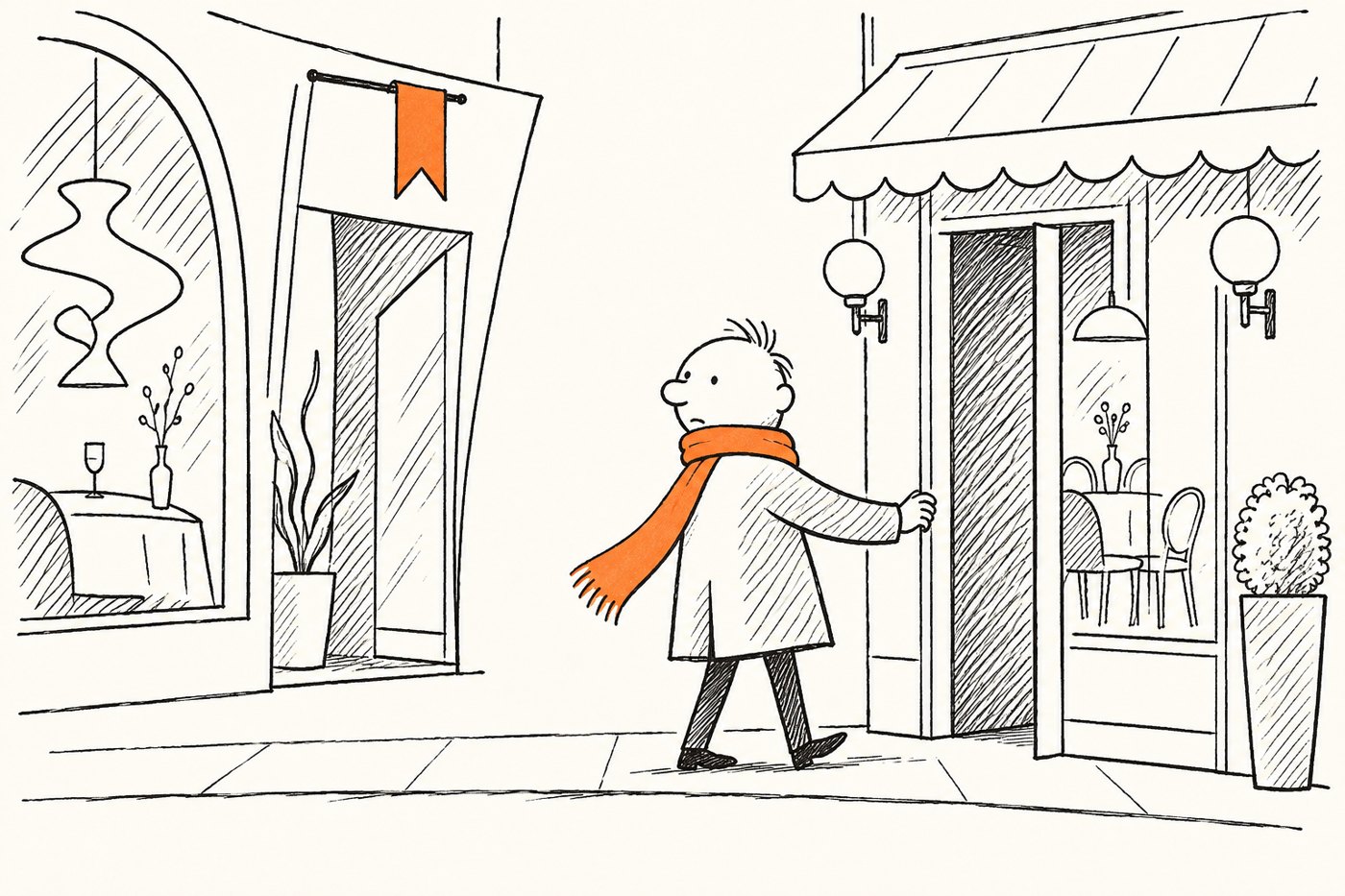
I always like looking at the places people bookmark to visit on OpenTable versus where they actually book. They bookmark the more ethnic, refined, avant-garde cuisine, but they end up booking the similarly priced but beige Ivy brasseries.
Or take movies. The highest rated on IMDb are things like The Shawshank Redemption, 12 Angry Men and The Godfather, but I bet if you look at box office takings or Netflix viewing figures, any low-rated Adam Sandler comedy would trump them all. In fact, here is the correlation between IMDb rating and gross takings to prove it.
- Adam Sandler comedies
- The Shawshank Redemption & The Godfather films
- Every other film
Data: IMDb ratings and The Numbers box office figures, via the vega-datasets collection. Box office isn’t adjusted for inflation.
Show the highlighted films as a table
| Film | Year | IMDb | Worldwide gross |
|---|---|---|---|
| The Godfather | 1972 | 9.2 | $269M |
| The Godfather: Part II | 1974 | 9 | $57M |
| The Shawshank Redemption | 1994 | 9.2 | $28M |
| Grown Ups | 2010 | 5.8 | $250M |
| Click | 2006 | 5 | $238M |
| Big Daddy | 1999 | 4.7 | $235M |
| 50 First Dates | 2004 | 6.8 | $196M |
| Anger Management | 2003 | 6.1 | $196M |
| The Longest Yard | 2005 | 6.2 | $190M |
| The Waterboy | 1998 | 5.7 | $190M |
| I Now Pronounce You Chuck and Larry | 2007 | 6.1 | $186M |
| Mr. Deeds | 2002 | 5.5 | $171M |
| Little Nicky | 2000 | 5 | $58M |
| Happy Gilmore | 1996 | 6.9 | $39M |
I find this is a big problem with most influencers. They hype up everything they try, saying it is the ‘best ever’ and rarely, if ever, giving a negative review, meaning you are no better off than before you started scrolling.
4. They don’t reflect the people who know
But maybe the biggest problem with reviews is that you don’t know who is leaving them.
I love eating out. Most would probably call me a ‘foodie’ (although I think it’s a cliché), and friends give me restaurant recommendations all the time. But there are probably only a small handful of people whose recommendations I will listen to and note down: the ones who have similar taste and experiences to me.
Or if I want to find a good Japanese restaurant, I could just look at Google and see what the average white English person thinks is a good izakaya, but I would much prefer to see what an expat from Tokyo thinks. Others may prefer the opposite, not necessarily wanting authenticity, just a good meal.
It’s the same with movies or consumer products. The rating of a movie or moisturiser by an 18-year-old TikTok influencer matters much less to me than that of the friends I have grown up with, who have similar interests or are at a similar stage in life to me.
The same goes for critics. A movie critic’s opinion will be shaped by the types of movies they enjoy, which may be different to my preferences, possibly even polar opposites, so a negative review from them may be a positive review for me.
I have this exact case with a restaurant critic: if he likes a new opening, I will often steer clear.
When buying a SaaS tool, the overall rating may be low, but if you read the rationale behind the lower ratings bringing the score down, it may be about features that aren’t relevant to you.
We also often give far too much credit to critics. They often don’t have more first-hand experience of their subject than anyone else; it is usually that they are just good writers and communicators (valuable, but far from a guarantee you can trust their recommendations).
Can we fix it?
Creating trustworthy review and rating systems that solve these problems relies on both more robust review platforms and more personalisation.
What can review platforms do?
To be truly valuable, review platforms need to work harder to be more deeply integrated into products and services, and rethink how they collect reviews, for example:
- Only accept reviews from verified buyers, to reduce spam or hoax reviews.
- For digital products, build their own integrations to collect reviews, ensuring their review screens are shown to all users (happy and unhappy).
- Look more at data to back up qualitative reviews: the average tenure of customers, word-of-mouth recommendations at signup, whether someone has posted about the product to their network (high signal), how activation and engagement compare to industry averages, and whether the user tried something else first that didn’t work.
- Rewrite questions to focus on behaviours (have you been before? did you hear about it from a friend?), and frame a score as being built up from 0, instead of assuming perfection and looking for reasons to reduce it.
- Implement smarter review algorithms, like Tabelog’s, that consider other purchases and reviews to try to determine domain expertise.
- Use stack ranking rather than rating to imply a rating. We aren’t good at assigning abstract ratings, but we are generally good at comparing two products or features: which did you prefer?
What can you do?
The most obvious thing you can do is use an AI agent to help you make purchasing decisions, making sure it has:
- Stored memory of successful purchases, products you use and preferences you have.
- A list of validated sources, or just people you trust and are generally aligned with on purchasing decisions.
- For each purchase, a clear picture of what is important to you and what you don’t care about in the product or service you’re looking for (ideally stack-ranked).
Is there a business opportunity here?
Two larger opportunities in particular spring to mind as I write this.
The first would be creating a modern, deeply integrated review platform, using some of the techniques described above. While all of this is possible for incumbents, they are not quick to innovate, so if you could demonstrate that you can create high-trust reviews and ratings, you could become a source for LLMs quicker than you think.
The second would be a platform that passively identifies, and allows people to share, their recommendations for products and services, where they are limited in what they can recommend: for example, only their #1 sports watch, no others, ideally linked back to a purchase. This makes people choose and vouch for individual items, creating a bit of skin in the game.